
Sliding vs Hinged Wardrobe Doors: Which Is Better for Your Room?

Choose sliding wardrobe doors if a bed, furniture or walkway leaves little space for doors to swing open. Choose hinged wardrobe doors when you have clear floor space and want to open the whole robe at once. Neither is universally better: usable depth, drawer access, the ceiling shape and your preferred finish all affect the decision.

Sultan’s Wardrobes designs and installs both types of made-to-measure wardrobe doors across Sydney. Use the comparison below to find the likely fit for your room, then confirm it at a free in-home measure.
Sliding vs hinged wardrobe doors: the main differences

The most important trade-off is floor clearance versus access. Sliding doors avoid an outward swing; hinged doors provide more simultaneous access to the wardrobe opening.

Wardrobe door decision matrix — Sydney made-to-measure wardrobes
Factor Sliding doors Hinged doors
Clearance No outward door swing Door leaves swing into the room
Storage access Part of opening accessible at a time Whole opening can be accessed when all doors open
Overall robe depth* 650–700 mm typical 620–640 mm typical
Internal drawers Need to align with accessible door opening More placement freedom, allowing for door and hinge clearance
Raked ceilings Requires a straight, level track, often with infill above Can accommodate stepped door heights in suitable designs
Finishes Framed melamine, glass and large mirror panels Flat, Shaker or profiled styles; mirrors also possible
Upkeep Keep tracks clean; rollers can be adjusted Hinges can be adjusted for alignment
Price Depends on number of panels, frame, inserts and hardware Depends on door leaves, finish, hinges and handles

*Overall depth: Indicative figures from Sultan’s wardrobe dimensions guide, assuming approximately 600 mm internal cabinetry depth. They are not door-swing clearances or guaranteed minimums. On mobile, swipe inside the table to compare both columns.

Which wardrobe doors suit your room?

Make the choice based on how the room is used, not just the appearance of the doors.

  • Bed or bedside table close to the robe: sliding doors are often more practical because nothing swings into the room.
  • Space to open all the doors: hinged doors provide a broad view of hanging, shelving and drawers.
  • Lots of internal drawers: hinged doors generally give more flexibility; sliding doors can still work if the drawers align with the door openings.
  • Raked ceiling or awkward corner: hinged doors often suit stepped or irregular configurations; sliding tracks need a straight level run.
  • Large full-length mirror: sliding mirror panels are a common option; hinged mirrors are possible where the design and hardware allow.
  • Restricted overall robe depth: hinged doors may save depth compared with sliding tracks, provided there is enough space to swing them open.

For a small room, measure both the wardrobe depth and the space in front. A sliding door removes the swing arc but does not remove the need to stand at the robe or pull out drawers.

Not sure which doors will work with your furniture and storage?

Get Advice at a Free Measure

How the doors actually open

These simple illustrations show the practical difference; they are not measured installation drawings. The descriptions below them explain the same facts without relying on the drawings.

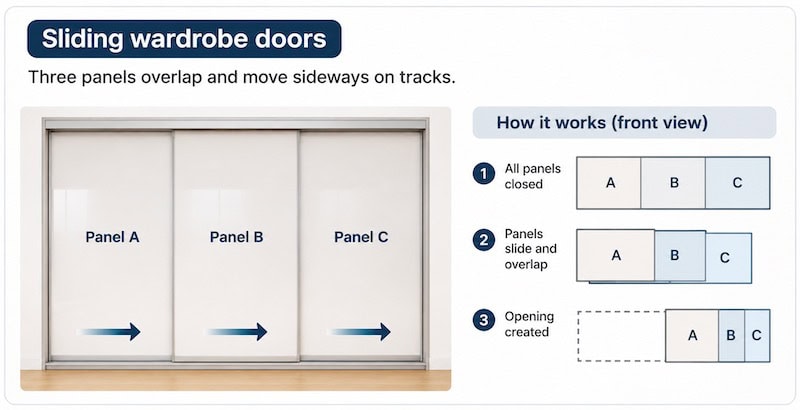
Sliding panels overlap and move sideways
Wardrobe opening
Panel A ↔
↔ Panel B

Panels pass each other on tracks. A section of the opening remains behind a panel, but no door swings into the bedroom.

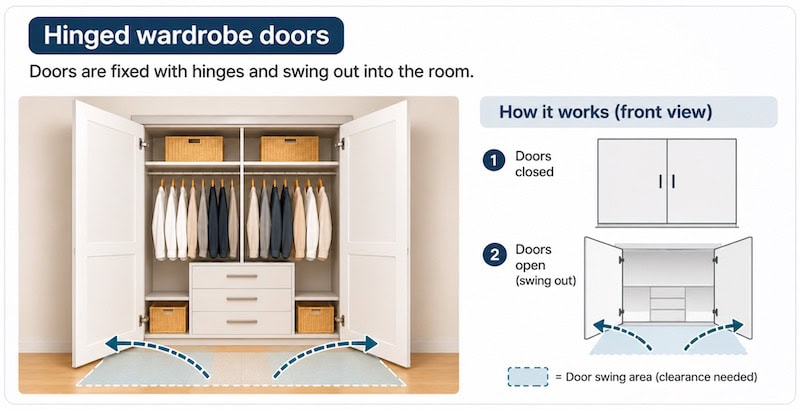
Hinged leaves swing into the bedroom
Wardrobe opening
↶ Leaf
Leaf ↷

Door leaves swing outwards. The door’s actual width and furniture position decide whether there is enough clearance.

Overall depth is different from swing clearance

With approximately 600 mm internal cabinetry depth, Sultan’s published guide gives 620–640 mm overall for hinged doors and 650–700 mm overall for sliding doors. Tracks add depth to sliding systems; hinged doors require additional clear floor space to open.

The hinged door leaf itself may be approximately 450–600 mm wide in a typical design, but it must be checked against the opening, furniture and the space needed to stand. For more measurements, read our wardrobe dimensions guide.

Sliding Wardrobe Doors Explained
Hinged Wardrobe Doors Explained

How door choice changes your wardrobe’s internals

Sliding doors: plan around the panel positions

Sliding wardrobe doors run on tracks and overlap. A two-panel system typically lets you reach roughly half the opening at once; the amount of access with three or more panels depends on the track layout and how the panels stack.

Drawers behind sliding doors need a completely clear opening. When planning the robe, Sultan positions drawer banks, shelving towers and hanging sections around the places where the door panels will sit when opened. A drawer behind an overlapping panel may be blocked even if the cabinet itself has enough depth.

Hinged doors: broader access when opened

Hinged wardrobe doors swing on concealed hinges, often arranged in pairs. They give more freedom to arrange drawers and shelves across the opening, provided drawer fronts still clear the doors and hinges. This is particularly useful when you want to open and see several storage zones together.

Neither system requires you to give up good internal storage. It needs to be designed around the doors from the start. Explore custom wardrobe internals for the hanging, shelving and drawer options.

What about raked ceilings, mirrors and finishes?

Sloping ceilings and awkward openings

Sliding doors need a straight and level top track. Under a raked ceiling, this may mean using a fixed panel or overhead cabinet above a lower, level track. Hinged doors can sometimes be made in stepped heights to work with the slope. Out-of-square walls and uneven floors need to be measured and allowed for in either system.

Matching the look of your room

Sliding door systems commonly have aluminium frames with melamine, mirror or glass inserts. Large mirrored wardrobe panels can replace the need for a separate bedroom mirror.

Hinged wardrobes can use flat or profiled panels, including Shaker and Hamptons-style designs. They may suit older Sydney homes and traditional interiors, though either door type can work in contemporary bedrooms. Mirrors are possible with hinged doors too, subject to appropriate panel and hardware selection.

Are sliding or hinged wardrobe doors cheaper?

Neither door system is automatically cheaper. Sliding pricing depends on the number and size of framed panels, the inserts, tracks and rollers. Hinged pricing depends on the number of leaves, door finish, hinges and handles. Soft-close hinges are an available upgrade, and mirrors or specialised finishes can affect either quote.

For a fair comparison, ask for the same wardrobe dimensions and a similar internal fit-out before comparing door options. See the built-in wardrobe cost guide for the wider cabinetry and installation factors.

Maintenance and longevity

  • Sliding doors: keep the bottom track free of dust, hair and grit. Roller adjustments may be needed if movement becomes uneven.
  • Hinged doors: concealed hinges can be adjusted if gaps become uneven or a leaf needs realigning.

Sultan’s Wardrobes’ published 10-year warranty covers workmanship and wardrobe components, subject to its terms.

How Sultan helps you make the final choice

  1. Measure the opening and room: check depth, ceiling, nearby furniture and the space for swinging doors or opening drawers.
  2. Plan the internals: discuss where hanging, shelves and drawers will go, and how each door system affects access.
  3. Compare suitable options: review door finishes, hardware and configurations. If you’re undecided, ask for both to be considered in the quote.
  4. Confirm the design: a made-to-measure robe is designed and manufactured to the agreed specification before installation.

The in-home measure is free, normally takes 20–60 minutes and is followed by a written quote usually within two days. Learn more about wardrobe installation in Sydney.

Sliding vs hinged wardrobe door FAQs

How much space do hinged wardrobe doors need?

A hinged leaf needs enough unobstructed floor space to swing open, plus room to stand and reach your clothing. A typical leaf may be around 450–600 mm wide, but the correct clearance depends on its actual width, hinges and surrounding furniture.

Do sliding doors use more wardrobe depth?

Usually, yes. Sultan’s dimensions guide gives 650–700 mm overall for typical sliding robes and 620–640 mm for hinged robes, based on approximately 600 mm internal cabinetry depth. Confirm the measurement for your selected design.

Can I have drawers behind sliding wardrobe doors?

Yes. The drawer banks must line up with the clear openings when the sliding panels are parked. Door widths and drawer positions need to be planned together.

Can hinged wardrobe doors have mirrors?

Yes. Mirrored panels can be used on hinged wardrobe doors as well as sliding doors where the door sizes and hardware make the design suitable.

Which wardrobe doors are cheaper?

Neither is always cheaper. The door count, selected finish, mirror or glass panels, hinges, tracks and other hardware affect the quote. Comparing matching specifications gives a more useful answer.

Can sliding doors be used under a raked ceiling?

They can, but a straight, level top track is required. A fixed panel or overhead cupboard may be used above the track. Hinged doors can sometimes be stepped to follow the slope instead.

Why do sliding doors stick or come off their tracks?

Dust or grit, damaged rollers or misalignment can affect a sliding door. Keep the track clean and have damaged or misaligned parts assessed rather than forcing the panel.

Do you offer soft-close hinges?

Yes. Soft-close hinges are available as an upgrade on hinged wardrobe doors and can be discussed at the free measure.

Explore the door systems

If you’ve narrowed down the choice, explore our sliding door wardrobes and hinged door wardrobes for the actual options, finishes and configurations. You can also see our wardrobe doors overview or compare specifications in the wardrobe dimensions guide.

Not sure which wardrobe doors will work in your room?

Book a free in-home measure. We will check the opening, furniture clearance and internal layout, then recommend sliding or hinged doors that suit your Sydney home.